
Selective Course Meaning
Selective Course Meaning - What's the difference between elective and selective? You could say optional or elective (not selective, but it would be understood what you mean). A 'selective college' typically refers to a school with a relatively low acceptance rate and high academic standards, meaning that it is more competitive and harder to gain admission. Sometimes we just abbreviate elective courses. An elective is a rotation you can choose, and have no requirement to complete. Unlike core courses, which are mandatory. Degree programs often, though not always, require both selectives and free electives. Selective tends to mean chosen from a larger number, while others were left out/unchosen/discarded, as in a selective school, or selection procedure. Both 'elective course' and 'optional course' are correct word choices to describe a course that is not required but chosen by the student. (a.) exerting the power of choice; Intentionally choosing some things and not others: They are interchangeable and convey the same. You could say optional or elective (not selective, but it would be understood what you mean). Degree programs often, though not always, require both selectives and free electives. A selective school is one that children…. These example sentences appear in various news sources and books to reflect the usage of the word ‘elective course'. Selective tends to mean chosen from a larger number, while others were left out/unchosen/discarded, as in a selective school, or selection procedure. Unlike core courses, which are mandatory. Core courses are always essential to an academic degree, but they are not necessarily foundational to your major. Selective, is when you can choose something, elective is when you can vote or elect something hope that helps Selective tends to mean chosen from a larger number, while others were left out/unchosen/discarded, as in a selective school, or selection procedure. Degree programs often, though not always, require both selectives and free electives. Here’s a list of social studies courses you might encounter in high school: Views expressed in the examples do not. Selective, is when you can choose. Electives are courses that count toward your credits for graduation, but are not requirements for your particular degree of study. These colleges are known for being highly competitive, where only a. A selective is a student selected clinical placement, which is meant to help further the goals and objectives of the transition to residency (ttr) course. Any courses offered at. Selective, is when you can choose something, elective is when you can vote or elect something hope that helps Views expressed in the examples do not. Collectively, core courses are part of a core curriculum. Elective courses, often known as optional classes, are those that are not compulsory within a student’s major or program. Core courses are always essential to. Selective tends to mean chosen from a larger number, while others were left out/unchosen/discarded, as in a selective school, or selection procedure. Here’s a list of social studies courses you might encounter in high school: These example sentences appear in various news sources and books to reflect the usage of the word ‘elective course'. These colleges are known for being. Collectively, core courses are part of a core curriculum. A selective college is an institution that has a high level of selectivity in its admissions process. Both 'elective course' and 'optional course' are correct word choices to describe a course that is not required but chosen by the student. Views expressed in the examples do not. You could say optional. What's the difference between elective and selective? This means a student is free to choose the study topics. A selective college is an institution that has a high level of selectivity in its admissions process. These colleges are known for being highly competitive, where only a. Selective tends to mean chosen from a larger number, while others were left out/unchosen/discarded,. Unlike compulsory courses that a student must take up to meet their program requirements, elective courses are taken by choice. Views expressed in the examples do not. Degree programs often, though not always, require both selectives and free electives. Elective courses, often known as optional classes, are those that are not compulsory within a student’s major or program. Selective tends. Unlike compulsory courses that a student must take up to meet their program requirements, elective courses are taken by choice. A 'selective college' typically refers to a school with a relatively low acceptance rate and high academic standards, meaning that it is more competitive and harder to gain admission. This means a student is free to choose the study topics.. Electives are courses that count toward your credits for graduation, but are not requirements for your particular degree of study. They are interchangeable and convey the same. Selective, is when you can choose something, elective is when you can vote or elect something hope that helps Here’s a list of social studies courses you might encounter in high school: You. A 'selective college' typically refers to a school with a relatively low acceptance rate and high academic standards, meaning that it is more competitive and harder to gain admission. Intentionally choosing some things and not others: A selective is a rotation you can place anywhere, but need to complete in a certain time period. Any courses offered at your college. Selective, is when you can choose something, elective is when you can vote or elect something hope that helps Degree programs often, though not always, require both selectives and free electives. It can be for positive. (a.) exerting the power of choice; It differs from an elective in that. These colleges are known for being highly competitive, where only a. It is important to understand the difference between the two and how each function in smart plan. Unlike compulsory courses that a student must take up to meet their program requirements, elective courses are taken by choice. These example sentences appear in various news sources and books to reflect the usage of the word ‘elective course'. Compulsory courses are usually prerequisites for selective courses, except when students can prove an exceptionally high proficiency level with authenticated evidence, then the course can. You could say optional or elective (not selective, but it would be understood what you mean). A selective college is an institution that has a high level of selectivity in its admissions process. Intentionally choosing some things and not others: Sometimes we just abbreviate elective courses. Here’s a list of social studies courses you might encounter in high school: Collectively, core courses are part of a core curriculum.
to the OKM Course Selection Meeting ppt download

Students reflect on course selection process The Evanstonian

PPT to North Quincy High School PowerPoint Presentation ID
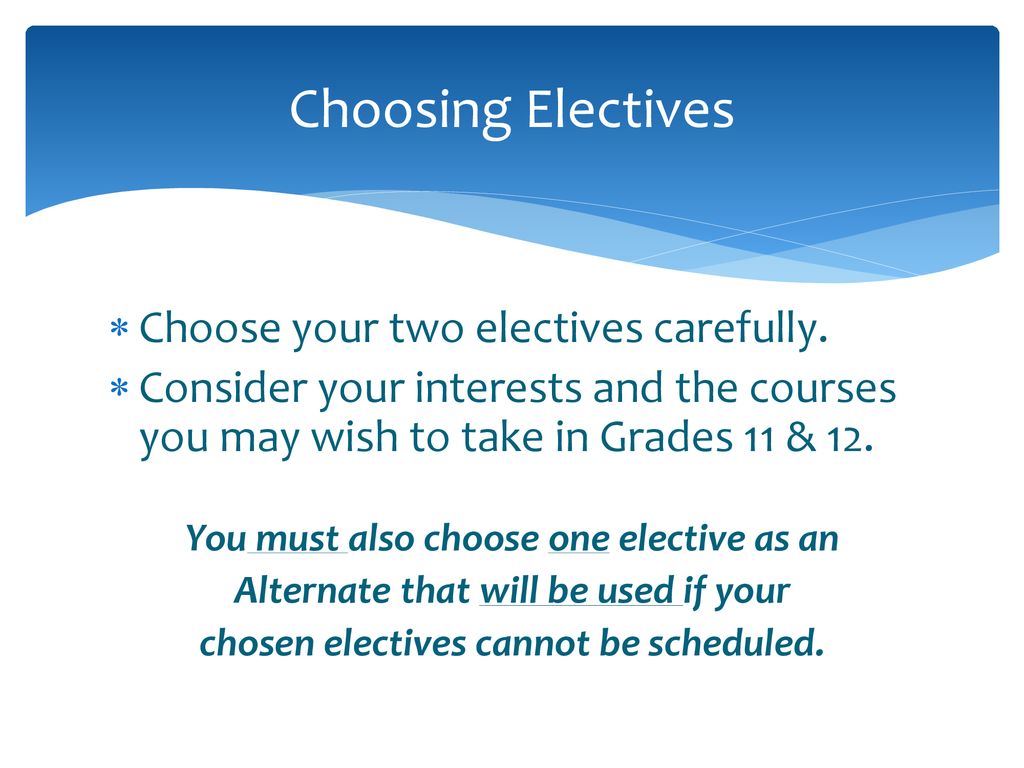
Entering Grade 10 Course Selection ppt download

PPT Class of 2015 PowerPoint Presentation ID6160747
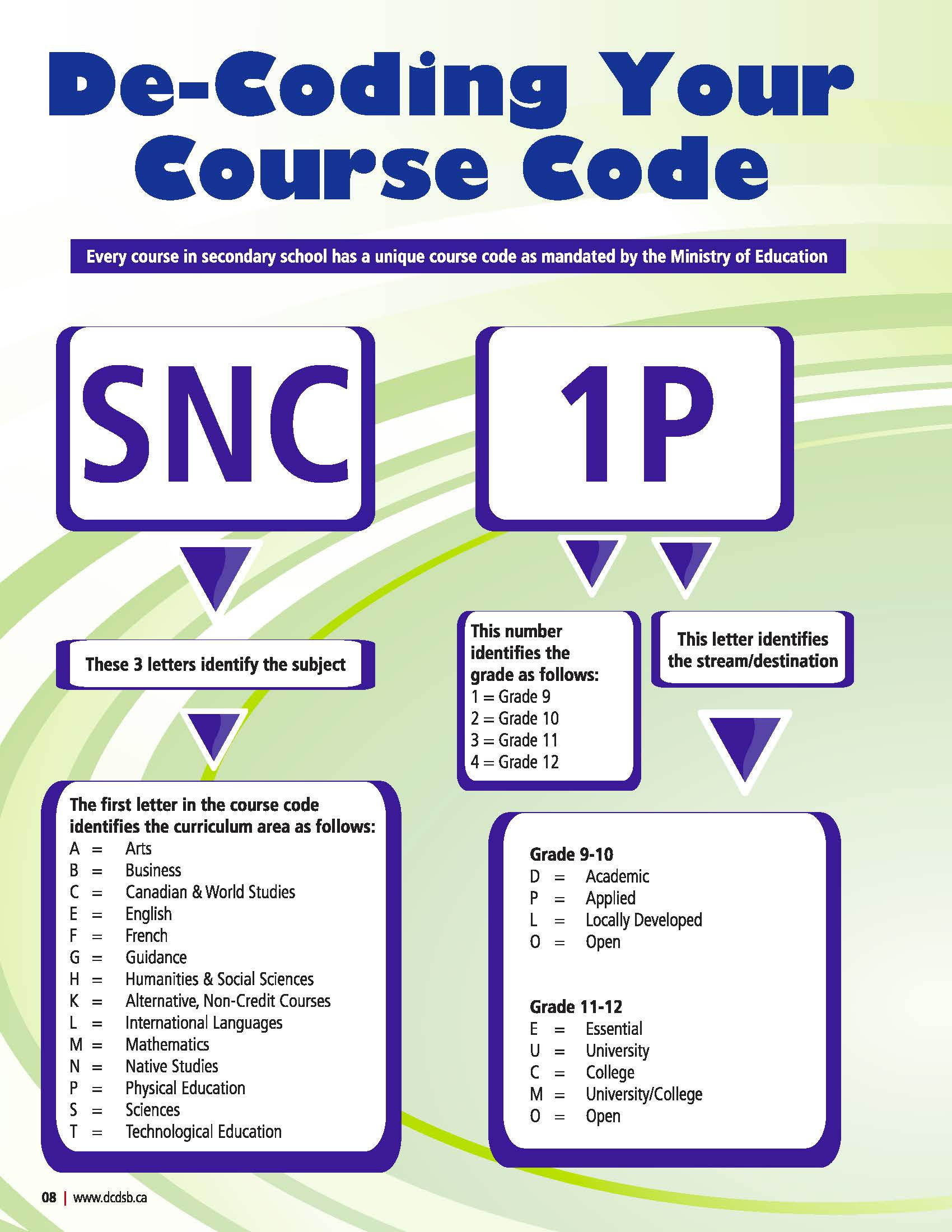
Course Selection, Levels and Calendar St. Mary Catholic Secondary School
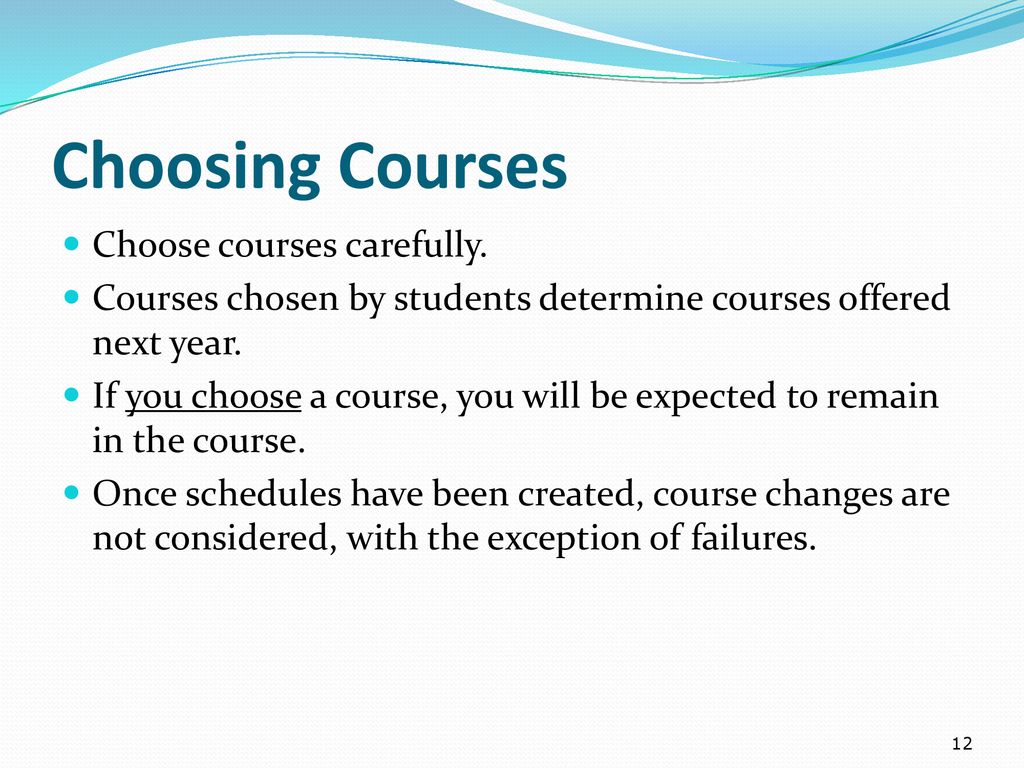
Entering Grade 12 Course Selection ppt download

新南威尔士大学unsw8621选课指南_考而思教育

Tuscola High School Counseling

Course Selection Night for 6th Grade Parents To DMS
Elective Courses, Often Known As Optional Classes, Are Those That Are Not Compulsory Within A Student’s Major Or Program.
Electives Are Courses That Count Toward Your Credits For Graduation, But Are Not Requirements For Your Particular Degree Of Study.
(A.) Pertaining To, Or Consisting In, Choice, Or Right Of Choosing;
They Are Interchangeable And Convey The Same.
Related Post: